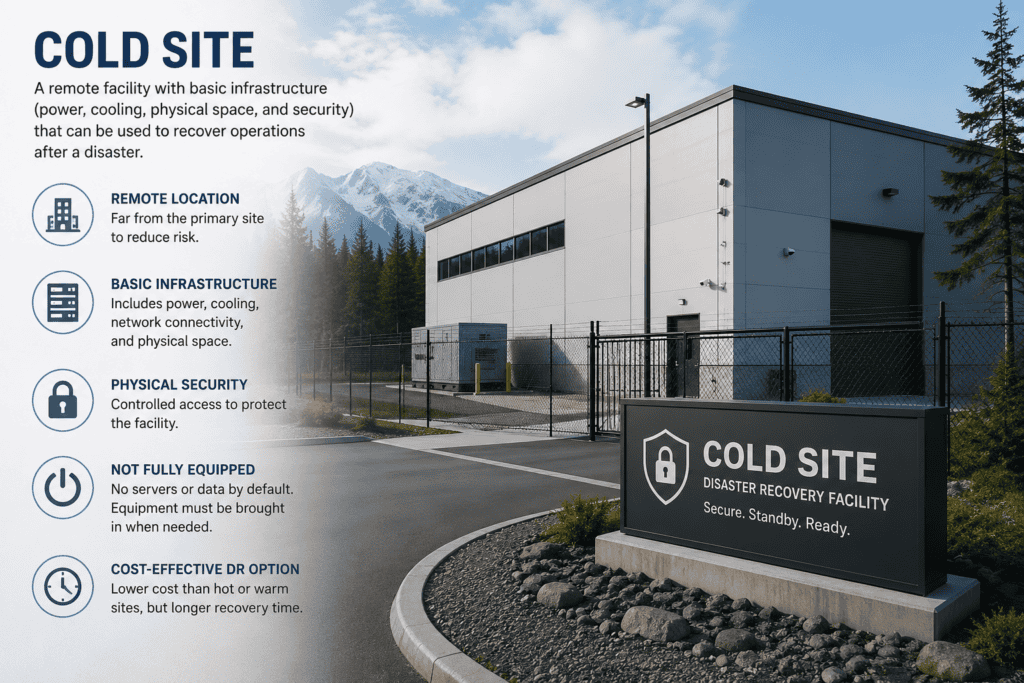
A Cold Site is a backup location that a company can use if its main building becomes unusable because of a disaster. Imagine your school suddenly cannot be used because of a fire, flood, or power failure. A cold site would be like an empty school building somewhere else. The building has walls, electricity, and maybe internet access available, but there are no desks, no computers, and no books inside. Everything must be brought in and set up before anyone can start working again.
In cybersecurity, cold sites are part of Disaster Recovery and Business Continuity Planning. Cybersecurity is not only about hackers and malware. Real world events like fires, storms, and earthquakes can shut down systems just as effectively. A cold site gives an organization a place to restart operations instead of being completely shut down forever. Even though it takes time to move equipment and restore systems, having a cold site means the business can survive a major disaster.
Cold sites are important for Security+ because they support the principle of Availability, which means systems and data must be accessible when needed. Cold sites usually have a long Recovery Time Objective, meaning it can take days to get systems back online. They are cheaper than warm sites and hot sites, which already have systems and data ready to go. On the exam, cold sites are often described as low cost and slow to recover.
Understanding cold sites helps Security+ students answer scenario based questions. You may be asked which solution fits a limited budget or which option has the slowest recovery time. A cold site protects an organization from total failure even though it does not offer quick recovery.
Related keywords
- Disaster Recovery
- Business Continuity
- Availability
- Recovery Time Objective
- Hot Site